Abstract: The paper will examine the causes of waterbody disintegration and the regeneration plans and solutions implemented by the government and corporations to stop the decline of the waterbodies in these districts. The number of lakes recorded in Gurugram has fallen by about 61% since 1956, and is still declining. The government has started some restoration processes to reduce the degradation and try to control and maintain the waterbodies. These waterbodies act as flood control, increase biodiversity in the area, increase groundwater recharge, and act as a social gathering area. They help in maintaining the ecological balance of a place. Excessive exploitation, uncontrolled urbanisation, increasing sewage dumping, and inefficient government control are major causes for the decline of these waterbodies. The paper will talk about these subjects more.
Keywords: Gurugram, waterbody disintegration, urbanisation, ecological balance, increase biodiversity, groundwater recharge
Introduction
The waterbodies in North India have been a great source of hotspots for flora and fauna. There are more than 100,000 lakes in northern India, even after urbanisation. The main focus of this paper is the lakes in Gurugram, Haryana. Revenue records list 251 lakes in the district (“Gurgaon Lost 389 Water Bodies,” 2018), which help maintain the hydrological cycle of this area, while also benefiting farmers with their crops and serving as flood mitigation measures. However, these lakes have been disintegrating rapidly, from 640 in 1956 to 251 in 2018. This is a loss of 389 lakes in about sixty years, an average of about six every year.
Research shows that the main cause of this decline in the number of water bodies in the Gurguram region can be seen from the excessive urbanisation that has been seen in this region of the state. This has led to the overutilization of groundwater in the development process, which has led to an overall decrease in groundwater levels. In Death and life of nature in Asian cities, 2021. Talk about the Ghata jheel (Ghata lake), which was once the deepest lake of the region, has been defaced. The disintegration of the lakes coincides with the uncontrolled urbanisation (Gururani, 2021).
Urban Cannibalism: A Self-Destructive Decay–The Duality of Ecological Dismay; Gurgaon also studies the effect of uncontrolled urbanisation on Gurugram’s water bodies and environment (Dev, 2017).
Some attention has been given to this problem; there have been some revival processes that have taken place, such as the revival of Najafgarh Jheel. However, solutions to address the problem of waterbody disintegration have not been implemented in multiple places. This paper will discuss how lakes have been degraded and explore potential solutions to help revive them.
Methodology
Data sources: this study used a secondary research method and relied mostly on academic articles, government reports, and case studies. Secondary data collection was used instead of primary data collection, such as land surveys, interviews, or government permission would have taken an unnecessary amount of time. From the resources that have been gathered, most of the degradation of the water bodies was due to the uncontrolled urbanisation. In The Death and Life of Nature in Asian Cities (2021), when Gurugram was being built, big developers such as DLF and Unitech took monopolistic control over the urbanisation of the newly developing city. The joint venture between the private and the government took control and gathered land from the farmers. The government and the big business took over and developed Gurugram from the farmers' land, and natural features such as hills, rivers, and lakes were exploited in the development of this city. The groundwater table has decreased drastically due to excessive urbanisation, which includes factors such as overpopulation, industrialisation, residential properties, and excessive extraction.
Restoring Najafgarh Jheel: An Ecohydrological Approach to Ecosystem Restoration, Mishra et al., 2025: In this case study, they talk about one of the revival projects they try to implement on one of the most prominent lakes in Gurugram. The first plan of action was that they tried to implement a permanent riparian buffer zone. By using plants with trees with phytoremediation capabilities, which are indigenous and have high tolerance for environmental stressors. The second plan of action was to make sewage treatment plants operational, industrial polluters had to pretreat their wastes before they were let into the water body, and public/private partnerships had to track high concentrations of pollutants entering the local waterbodies. Thirdly, they tried to take legal action and give the lake legal protection, and tried to have community awareness programs. To date, the restoration process has not been fully finished; there have been some troubles in the way, but there is still much expectation for it to be helpful in the groundwater recharge and increasing the biodiversity of the region. (Mishra et al., 2025)
Assessments and measures
The lakes in Gurugram have been deteriorating at a rapid pace due to uncontrolled urbanisation and the exploitation of resources. The data on these topics has not been onsite; most of them have been online.
Causes
The main causes of the deterioration of the waterbodies are:
- Encroachment and Urbanisation: the areas are being overtaken by farming, residential, and corporate use. Creating land by filling the water bodies.
- Water Pollution: untreated or partially treated waste entering the waterbodies. Soil dumping, agricultural runoff, and industrial effluents.
- Hydrological disturbance: turning of rivers that feed the waterbodies into drains, blocking of water sources by barriers, and excessive water extraction
- Poor Governance: notification and management of government decisions are delayed
- Invasive species: invasive plants such as the Hyacinth block up the water supply
- Climate change: Most of the lakes and waterbodies in Gurugram are seasonal and start to vanish in the peak summer
- Fragmented Ownership: Ownership of the lands in which the lakes are present is mostly fragmented, so no one is responsible for maintaining the land.
Solutions
The solutions to some of these problems can also be found
- Control of Invasive Species: control and remove invasive species such as Hyacinth to unblock the streams
- Clear Division of Responsibility: The government should take the initiative to give responsibility for maintaining the lakes in fragmented lands
- Sewage Treatment: sewage and runoffs should be treated before being let into the lakes or waterbodies to ensure less pollution
- Restoring Natural Drainage: natural drainage streams should be unblocked, making a clear connection between the lakes and the catchment areas
- Legal protection: The government should provide legal protection to waterbodies and wetlands, restricting the construction of building structures in the upper catchment area.
- Spreading Awareness: awareness should be spread to the community about the ongoing deterioration of the waterbodies in the region
- Waste Control: control should be given on the dumping of solid waste into the waterbodies.
- Physical and chemical-biological treatment techniques: restoration techniques contain physical techniques and chemical techniques. Physical techniques contain pollution flushing, sediment dredging, aeration, and mechanical algal removal, which help restore the water flow, remove pollutants and improve circulation. Chemical-biological restoration methods contain constructed wetlands, floating treatment plants, biofilm bioremediation, and biological-ecological techniques: planting native vegetation, reintroducing aquatic plants, restoring natural habitats and stabilising the ecosystem. This helps in water purification, nutrient removal, and ecological balancing (Addo-Bankas et al., 2022).
Effect on Wazirabad lake
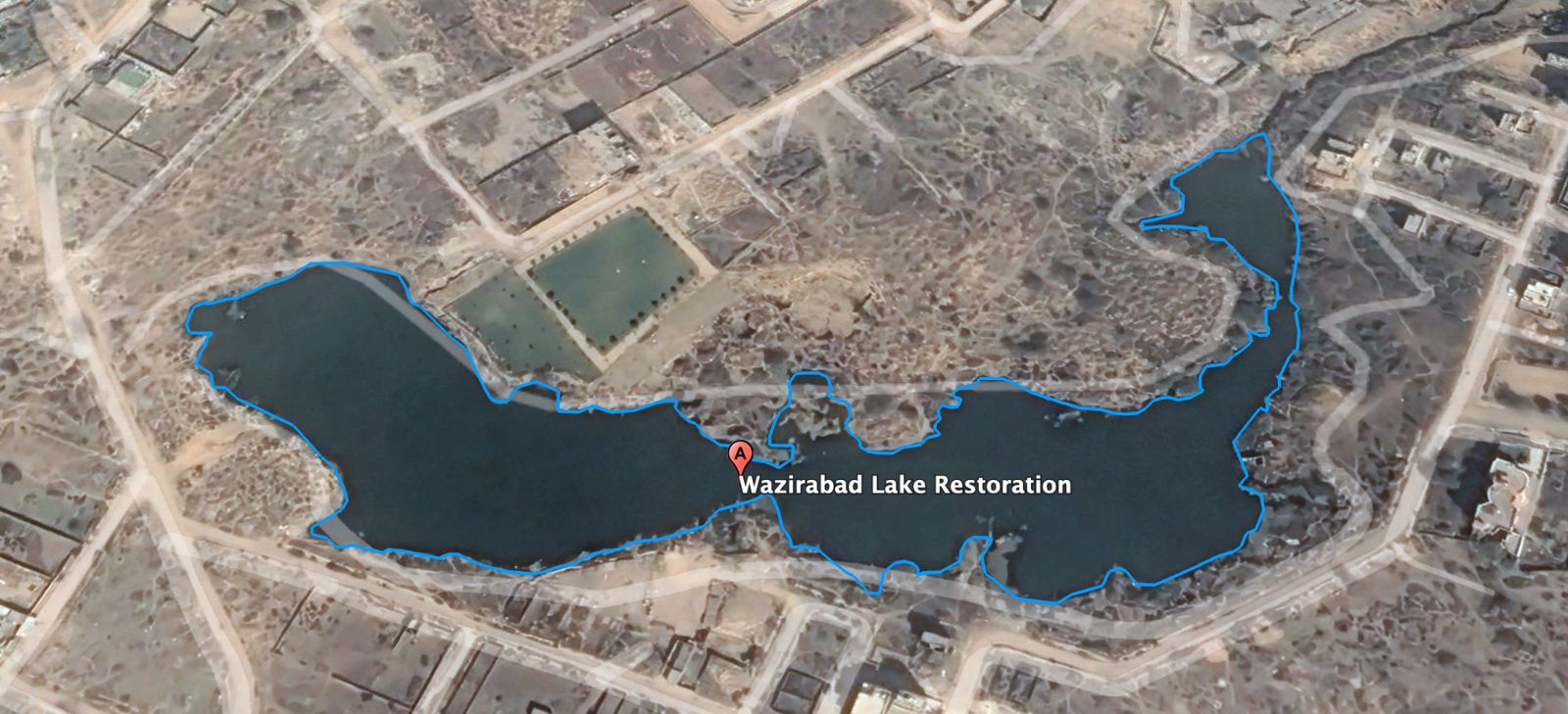
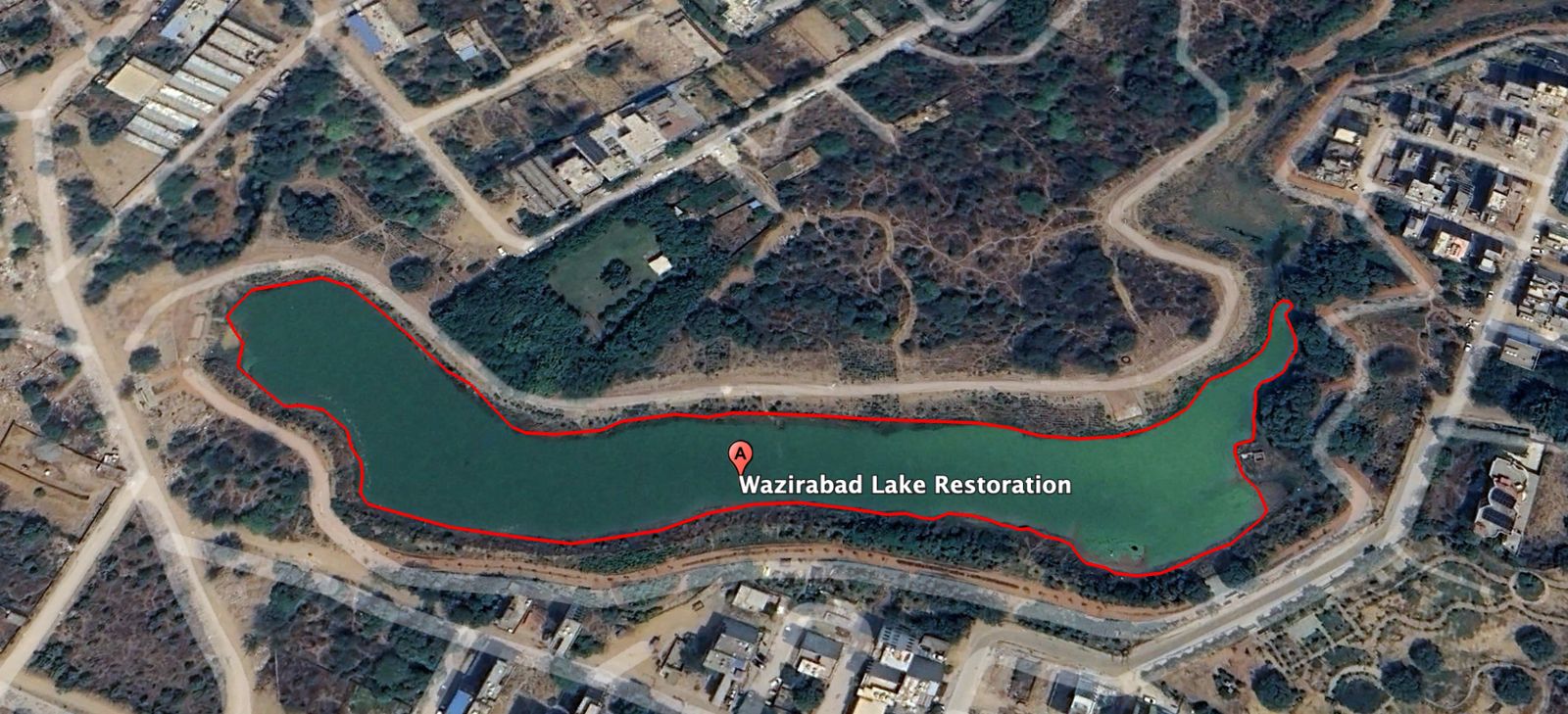
Wazirabad Lake had been a dumping ground for solid waste and untreated sewage (Jamwal, 2025). Seeing the degrading situation, Gurgaon Metropolitan Development Authority (GMDA), in collaboration with Sustainable Environment and Ecological Development Society (SEEDS). Initiated restoration efforts to improve the ecological health of the water body
Changes
- There is less pollution in the lake, compared to 2014
- More social development in the surroundings of the lake( jogging tracks, etc.)
- The lake is now fenced to stop solid waste dumping
- More trees were planted in the area to support biodiversity
- The sewage is treated before entering the lake
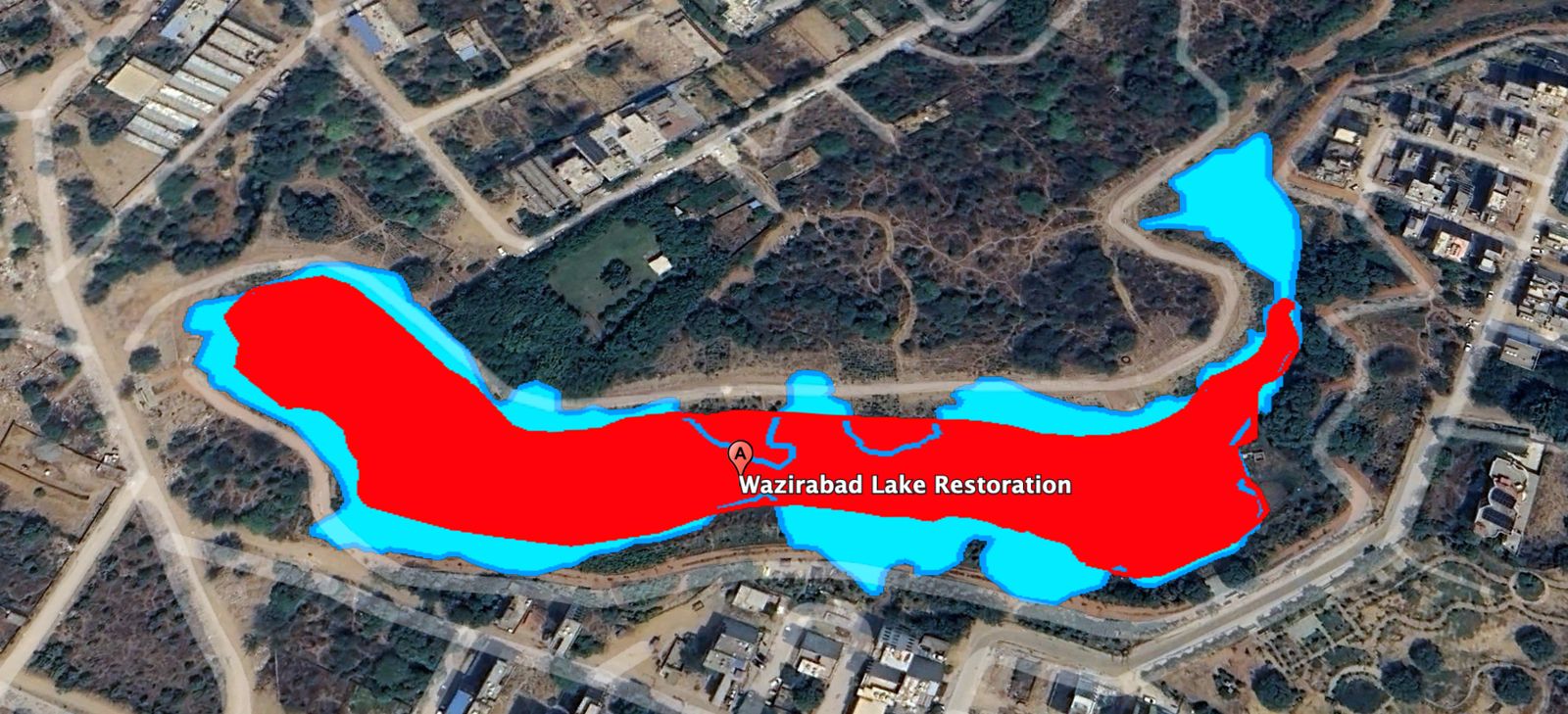
- But, there is a significant decrease in the size of the lake (499 meters decrease in perimeter and 8609 square meters decrease in area)
Methods for maximum efficiency for restoration in Gurugram
For the restoration of the waterbodies in Gurugram, those that are highly cost-effective and do not restrict urbanisation. These processes should interweave with the development of the district and not restrict it.
- Legal measures: The most important methods which should be necessary for the restoration of the waterbodies and maintaining them are government intervention. The government should be sterner and implement laws regarding the restriction of waste dumping and encroachment of the land of the waterbody. The government should also specify the regulation of the lakes under different bodies, for example, GMDA for big lakes and Rural Panchayats for small lakes.
- Sewage treatment: New sewage treatment plants should be constructed to manage the increasing water level. Multiple sewage treatment plants should be used. Interception of the sewage drains before they reach the lake at the STP. Industrial effluents should be treated and made mandatory.
- Ecological restoration: Riparian buffer zones should be placed, which involves the planting of plants and shrubs on the boundaries of the lake, which act like natural filters. Floating treatment Wetlands should be made, these are rafts that are floating on the lake and carry plants (Phragmites, Vetiver, Canna), their roots absorb the heavy metals in the water. Invasive plants should be removed and replaced with native aquatic plants. Rainwater harvesting should be directed towards the waterbodies to help fill them up
- Citizen and community engagement: the community should be made aware of the ongoing problem regarding the deterioration of the lakes. There should be community drives, eco-drives, eco-clubs, etc
Results
The main three drivers of the deterioration of the lakes in Gurugram which were seen from all the sources are, Land encroachment and urbanization of water catchment areas, such as Najafgarh jheel whose 10.5% of flood plain had been urbanized by 2020 by housing sectors, and Ghata jheel which was once approximately 300 acres has now fully finished as realestate and urbanization which has cut of its catchment. Sewage inflows, such as the basai wetlands, which are used as a dumping point for Gurugram drainage and act as a sewage pond rather than a lake, make it a place for foul smells and mosquito breeding. Loss of Hydrology, Damdama Lake, whose catchment area was blocked by excessive mining and urbanisation, decreasing its size (Rao, 2026).
Currently, there are 251 lakes in the district (“Gurgaon Lost 389 Water Bodies,” 2018). Of the 75 lakes identified in the Gurugram metropolitan area, 45 are being restored by GMDA (Jamwal, 2025). This is 60% of the lakes identified there, but only about 18% of the 251 that remain in the district. Mission Amrit Sarovar, started by the government, aims to rejuvenate 75 water bodies in every district (Ministry of Jal Shakti, 2022). Across the Gurugram district, 142 ponds have been identified for rejuvenation; work on 68 of them (48%) has been completed and 74 are under way. Within the Municipal Corporation of Gurugram area, 32 ponds have been redeveloped and work on another 21 is in progress (Sharma, 2026).
Discussion
This study showed that the major problems for the deterioration are the excessive urbanisation, untreated sewage dumping, and excessive exploitation of water. The past research found that excessive urbanisation is directly linked to the deterioration of the water bodies. Declining of waterbodies not only results in the decline in the groundwater level, but also loss in biodiversity, flood control, social activities, etc.
If the government does not take swift and efficient action, there will come a time when the waterbodies in Gurugram will perish forever. The number of waterbodies in the district’s revenue records has declined by about 61% since 1956 (“Gurgaon Lost 389 Water Bodies,” 2018). The GMDA inventory, which also counts waterbodies found on satellite and drone images, gives a lower figure: 153 of 644, about 24%, have vanished beyond revival, and with the 53 that face existential pressures, about a third (32%) are lost or close to it (GMDA, 2019). The two sources count differently, but both show a large loss that is still continuing. The inventory also shows where the loss falls. The vanished waterbodies are 24% of the total by number but only 16% by area, so it is mainly the small ponds that disappear. Of the 153, 98 were on private land, which means that 57% of the privately owned waterbodies have vanished, against 8% of those owned by gram panchayats. With the ongoing and excessive urbanisation, there would be a stop to the decline unless the government takes some action.
This research has its own downsides as it is based on secondary research, as well as primary sources. Future studies should incorporate the effect of the solutions on the decline of the water bodies to provide solid proof.
Conclusion
Findings of this paper show that the waterbody degradation in Gurugram is majorly driven by rapid and uncontrolled urbanisation, untreated sewage discharge, hydrological disturbance and poor governance. Lakes that once supported the biodiversity, increased groundwater recharge, and drove community activities have decreased in number and are continuing to decrease in number. Although some government initiatives are happening, such as the GMDA waterbody revival plan and the Amrit Sarovar mission.
Long-term sustainability of Gurugram's water systems will require the strengthening of the restoration efforts with legal protection of wetlands, improvement in sewage treatment, and ecological interventions, including riparian buffers and floating wetlands, among others. Further research will be required to test the effectiveness of these solutions through direct data collection, which can establish whether current interventions are adequate to reverse ecological decline.
Ultimately, saving the remaining lakes in Gurugram is an environmental imperative and also essential for ensuring groundwater security, climate resilience, and overall well-being of the region's population.
References
- Addo-Bankas, O., Zhao, Y., Gomes, A., & Stefanakis, A. (2022). Challenges of urban artificial landscape water bodies: Treatment techniques and restoration strategies towards ecosystem services enhancement. Processes, 10(12), 2486. https://doi.org/10.3390/pr10122486
- Dev, A. (2017). Urban cannibalism: A self-destructive decay – the duality of ecological dismay; Gurgaon. International Journal on Emerging Technologies, 8(1), 297–303.
- Gurgaon lost 389 water bodies in 60 years: Study. (2018, January 22). The Times of India. https://www.indiaenvironmentportal.org.in/news-clippings/gurgaon-lost-389-water-bodies-in-60-years-study
- Gurugram Metropolitan Development Authority. (2019, May 2). Water bodies in district Gurugram [Compliance report in O.A. No. 325 of 2015, Lt. Col. Sarvadaman Singh Oberoi v. Union of India & Ors.]. National Green Tribunal. https://www.greentribunal.gov.in/sites/default/files/all_documents/GMDA-Compliance%20Report%20In%20O.A.%20No.%20325%20of%202015.pdf
- Gururani, S. (2021). Making land out of water: Ecologies of urbanism, property, and loss. In A. Rademacher & K. Sivaramakrishnan (Eds.), Death and life of nature in Asian cities (pp. 138–158). Hong Kong University Press.
- Jamwal, N. (2025, June 18). Gurugram has revived its Wazirabad lake. Can it replicate this success with other water bodies? Down To Earth. https://www.downtoearth.org.in/water/gurugram-has-revived-its-wazirabad-lake-can-it-replicate-this-success-with-other-water-bodies
- Ministry of Jal Shakti. (2022, July 21). Restoration of water bodies [Press release]. Press Information Bureau, Government of India. https://www.pib.gov.in/PressReleaseIframePage.aspx?PRID=1843391
- Mishra, A., Hamby, J., Cepeda, A., & Tufail, M. (2025). Restoring Najafgarh Jheel: An ecohydrological approach to ecosystem restoration. Taylor & Francis. https://www.taylorfrancis.com/cw/10.4324/70f89840-6d56-45df-a1d9-6bbd9abc32e5
- Rao, R. (2026, January 15). Time and neglect have altered Damdama Lake in Gurugram. But it still holds promise. Down To Earth. https://www.downtoearth.org.in/water/time-and-neglect-have-altered-damdama-lake-in-gurugram-but-it-still-holds-promise
- Sharma, S. (2026, October 6). Gurugram bets on rainwater recharge to curb waterlogging. The Tribune. https://www.tribuneindia.com/news/gurugram/gurugram-bets-on-rainwater-recharge-to-curb-waterlogging
This paper led to the Blue Patch Initiative, the restoration of Badshahpur Pond in Sector 68, Gurugram.
Revised October 2026: the lake counts are now cited to their source (The Times of India, 2018), the decline since 1956 has been corrected from 40% to 61%, figures from GMDA (2019), Jamwal (2025) and Sharma (2026) have been added, and missing citations have been supplied.